-
Leg Press
The Leg Press develops strength in the hip and thigh muscles. Perform the exercise as follows:
- The starting position for the Leg Press is the Sitting position with the knees bent at 90 degrees and feet flat on the foot platform.
- Place the hips, low back, shoulders, and head firmly against the seat back with the eyes looking straight ahead.
- Maintain a natural arch in the lower back.
- Select the appropriate weight and ensure the pin is secure in the weight stack.
- Keep hands relaxed and placed on the handgrips.
- On count 1, straighten the legs slowly until they are fully extended but not locked.
- On count 2, return to the starting position in a slow, controlled motion.
- Repeat this movement for the correct number of repetitions and sets required to meet the goal of the strength machine session.
-
Leg Curl
The Leg Curl is the second exercise in the Strength Training Machine drill. This exercise develops strength in the back of the upper leg muscles. Perform the exercise as follows:
- The starting position for the Leg Curl is the Prone position, knees aligned with the center axis of the machine.
- Adjust the lower leg pad to contact the lower legs just above and behind the ankle, allowing the lower legs to be fully extended.
- Relax the lower legs and feet. Position the thigh pad just above and in front of the knees.
- Place the hips, stomach, and chest firmly against the bench with the eyes looking straight down.
- Select the appropriate weight and ensure the pin is secure in the weight stack.
- Relax hands and place them on the handgrips.
- On count 1, slowly pull the lower legs to the rear toward the buttocks.
- On count 2, return to the starting position by slowly lowering the lower legs.
- Repeat this movement for the correct number of repetitions and sets required to meet the goal of the strength machine session.
-
Lateral Raise
The Lateral Raise develops strength in the shoulder and neck muscles. Perform the exercise as follows:
- The starting position for the Lateral Raise is the Sitting position with the knees bent at 90 degrees and feet flat on the floor.
- From the starting position, stay seated with the feet firmly on the ground. Adjust the seat so a 90- degree angle is formed between the upper and lower arms.
- Place the hips, lower back, shoulders, and head firmly against the seat back with the eyes looking straight ahead.
- Maintain a natural arch in the lower back.
- Select the appropriate weight and ensure the pin is secure in the weight stack.
- On count 1, raise both arms upward until they are parallel to the ground.
- On count 2, return to the starting position.
- Repeat this movement for the correct number of repetitions and sets required to meet the goal of the strength machine session.
-
Single-Arm Lateral Raise
The Single-Arm Lateral Raise is performed much like the Lateral Raise but using only one arm at a time. The range of motion and resistance is decreased for the injured side. As your condition improves, the range of motion and resistance may gradually increase until the exercise is performed to standard. However, do not increase both of these factors at the same time. The Single-Arm Lateral Raise is used to maintain a heavy resistance on the good side, reduce the resistance on the injured side, or both.
-
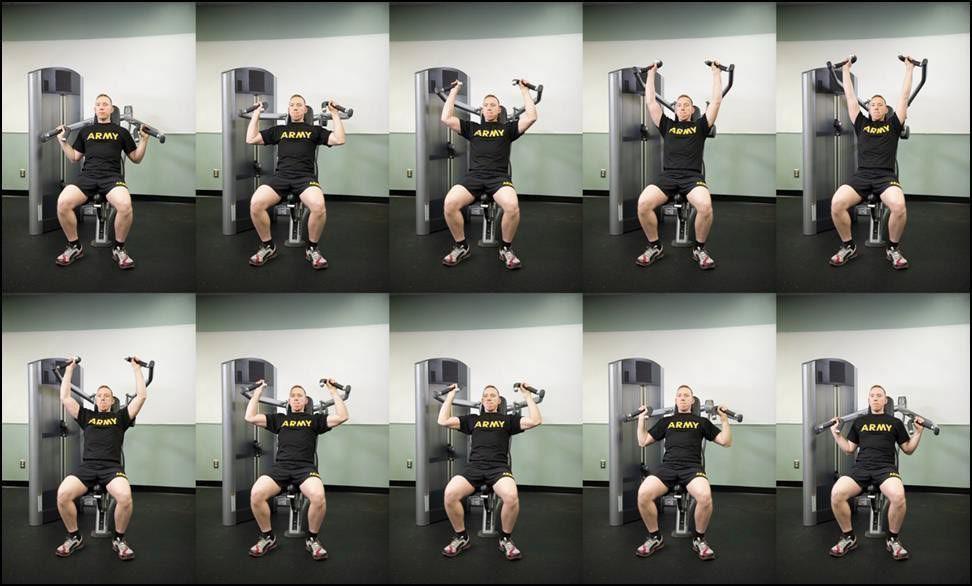
Overhead Press
The Overhead Press develops strength in the arm and shoulder muscles. Perform the exercise as follows:
- The starting position for the Overhead Press is the Sitting position with the knees bent at 90 degrees and feet flat on the floor.
- From the starting position, stay seated with the feet firmly on the ground.
- Adjust the seat to achieve a 90-degree angle between your upper and lower arms with the shoulders directly below the handgrips.
- Place the hips, low back, and shoulders firmly against the seat back.
- Look straight ahead.
- On count 1, push upward until both arms are fully extended but not locked.
- On count 2, return to the starting position.
- Repeat this movement for the correct number of repetitions and sets required to meet the goal of the strength machine session.
-
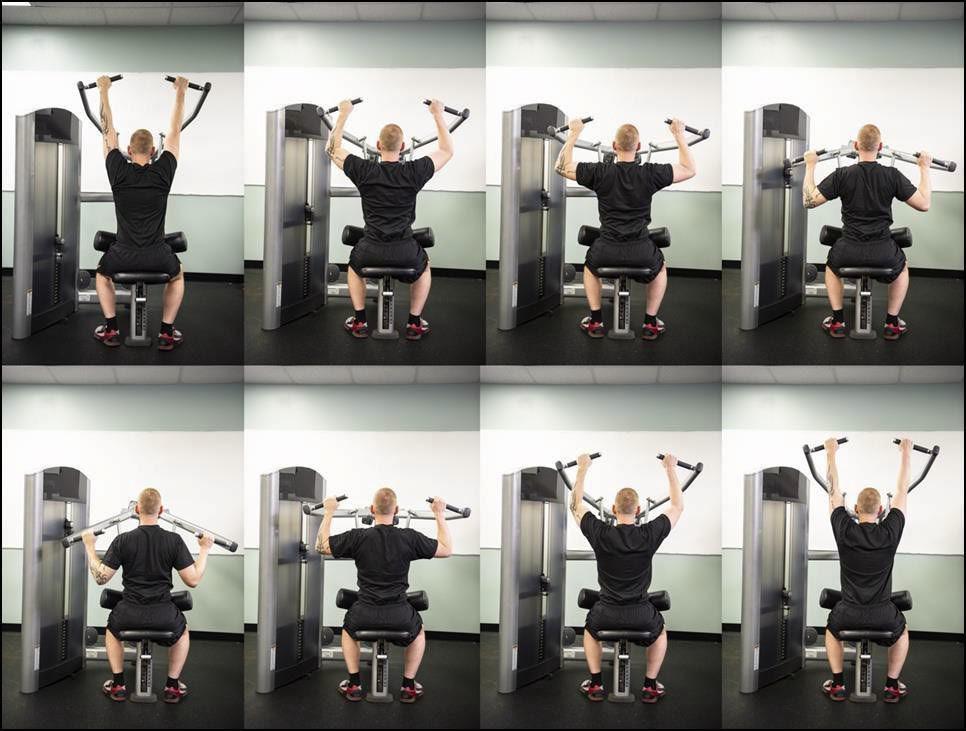
Lat Pull-Down
The Lat Pull-Down is the fifth exercise in the strength training machine drill. This exercise develops strength in the arm and back muscles. Perform the exercise as follows:
- The starting position for the Lat Pull-Down is the Sitting position with the knees bent at 90 degrees and feet flat on the floor.
- From the starting position, select the appropriate weight and ensure the pin is secure in the weight stack.
- Sit erect and adjust the roller pad so it sits firmly against the upper thigh and hip.
- Grasp the bar with a closed, pronated grip and assume a Sitting position with the hips against the roller pad and the feet flat on the ground.
- Check the upper body is perpendicular to the floor.
- On count 1, keeping the arms straight and elbows rotated out to the side and slightly flexed, simultaneously bend the elbows and pull the bar toward the shoulders until the upper arms are parallel to the ground.
- On count 2, return to the starting position by slowly extending the elbows.
- Repeat this movement for the correct number of repetitions and sets required to meet the goal of the strength machine session.
-
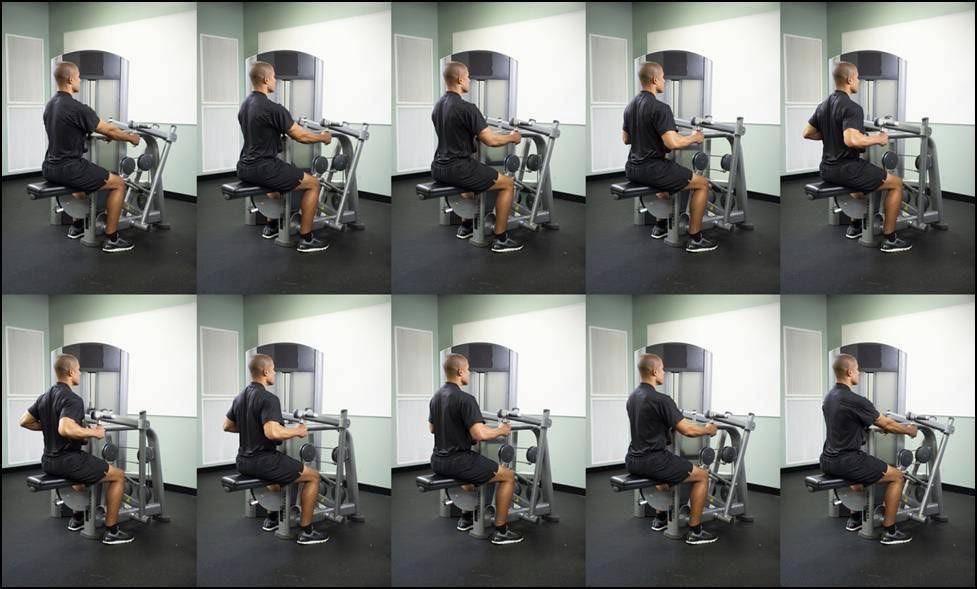
Seated Row
The Seated Row develops strength in the arm and back muscles. Perform the exercise as follows:
- The starting position for the Seated Row is the Sitting position with the knees bent at 90 degrees and feet flat on the floor.
- From the starting position, stay seated with the feet firmly planted on the floor or foot supports (if using).
- Lean forward and grasp the handgrips with the hands in a neutral, closed grip.
- Sit erect so the upper body is perpendicular to the floor.
- Select the appropriate weight and ensure the pin is secure in the weight stack.
- On count 1, simultaneously bend the elbows and pull the handgrips to the chest or upper abdomen while keeping the trunk rigid and the back flat.
- On count 2, return to the starting position by slowly extending the elbows.
- Repeat this movement for the correct number of repetitions and sets required to meet the goal of the strength machine session.
-
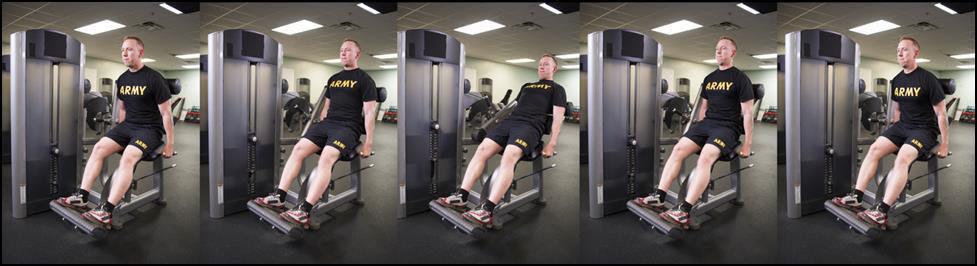
Trunk Extension
The Trunk Extension is the seventh exercise in the Strength Training Machine drill. This exercise develops strength in the low back muscles and supports the Deadlift exercise. Perform the exercise as follows:
- The starting position for the Trunk Extension is the Sitting position with the knees slightly bent and feet flat on the foot platform.
- From the starting position, stay seated on the machine, leaning slightly forward, with the back firmly against the padded lever arm.
- Select the appropriate weight and ensure the pin is secure in the weight stack.
- Grip the support bars using a neutral, closed grip.
- Keep the head in a neutral position with the eyes looking straight ahead.
- On count 1, raise the upper body and continue extending the trunk, moving to the Supine position.
- On count 2, return to the starting position.
- Repeat this movement for the correct number of repetitions and sets required to meet the goal of the strength machine session.
-
Modified Trunk Extension
The modified Trunk Extension should be used when a DA Form 3349 may limit the range of motion at which you can safely perform Trunk Extension exercises. The weight load should be low and the range of motion of the movements should be within your comfort zone. Gradually increase the weight load and range of motion as tolerated until the exercise can be performed to standard.
-
Triceps Extension
The Triceps Extension develops strength in the triceps muscles and supports other pushing tasks found in training and combat. Perform the exercise as follows:
- Select the weight and ensure the pin is secure in the weight stack.
- Conduct this exercise from the Sitting position. Start with the feet placed firmly on the ground. Place the hips and low back firmly against the seat back with the eyes looking straight ahead.
- Maintain an erect position, eyes looking straight ahead, grasping the bar with a closed, pronated grip.
- On count 1, push downward until both arms are fully extended but not locked.
- On count 2, return to the starting position.
- Repeat this movement for the correct number of repetitions and sets required to meet the goal of the strength machine session.
-
Chest Press
The Chest Press develops strength in the arms, shoulders, and chest muscles. Perform the exercise as follows:
- The starting position for the Chest Press is the Sitting position with the knees bent at 90 degrees and feet flat on the floor.
- From the starting position, stay seated with the feet firmly on the ground. Adjust the seat so a 90- degree angle is formed between the upper and lower arms with the shoulders directly below the handgrips.
- Place the hips, low back, shoulders, and head firmly against the seat back with the eyes looking straight ahead.
- Maintain a natural arch in the lower back.
- Select the appropriate weight and ensure the pin is secure in the weight stack.
- On count 1, push upward until the arms are fully extended but not locked.
- On count 2, return to the starting position.
- Repeat this movement for the correct number of repetitions and sets required to meet the goal of the strength machine session.
-
Trunk Flexion
The Trunk Flexion is the tenth exercise in the strength training machine drill. This exercise develops strength in the abdominal muscles. Perform the exercise as follows:
- The starting position for the Trunk Flexion is the Sitting position with the knees bent at 90 degrees and feet flat on the floor.
- From the starting position, stay seated with the feet firmly on the ground.
- Select the appropriate weight and ensure the pin is secure in the weight stack.
- Keep the elbows shoulder-width apart and bent at 90 degrees, with hands in a closed grip.
- Place the hips and low back firmly against the seat back with the eyes looking straight ahead.
- On count 1, bend forward, flexing the trunk and bringing the chest to the thighs.
- On count 2, return to the starting position.
-
Modified Trunk Flexion
The modified Trunk Flexion should be used when a DA Form 3349 may limit the range of motion at which you can safely perform Trunk Flexion exercises. The weight load should be low and the range of motion of the movements should be within your comfort zone. Gradually increase the weight load and range of motion as tolerated until the exercise can be performed to standard.
-
Leg Press
-
Leg Curl
-
Lateral Raise
-
Single-Arm Lateral Raise
-
Overhead Press
-
Lat Pull-Down
-
Seated Row
-
Trunk Extension
-
Modified Trunk Extension
-
Triceps Extension
-
Chest Press
-
Trunk Flexion
-
Modified Trunk Flexion
-
Leg Press
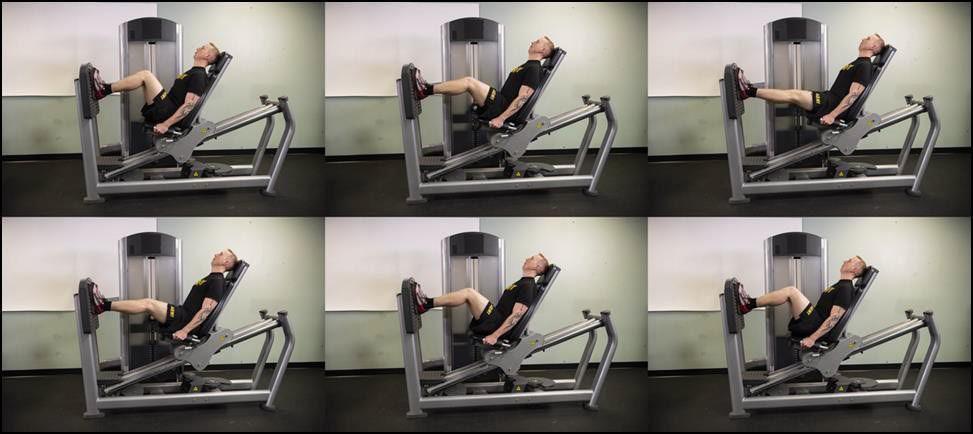
STM Leg Press -
Leg Curl
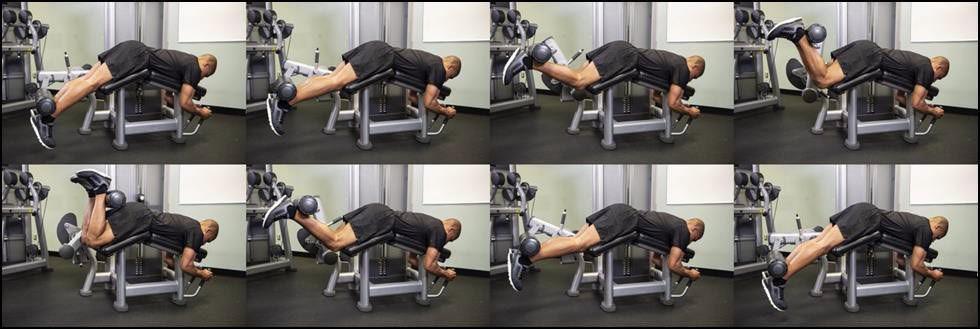
STM Leg Curl -
Lateral Raise
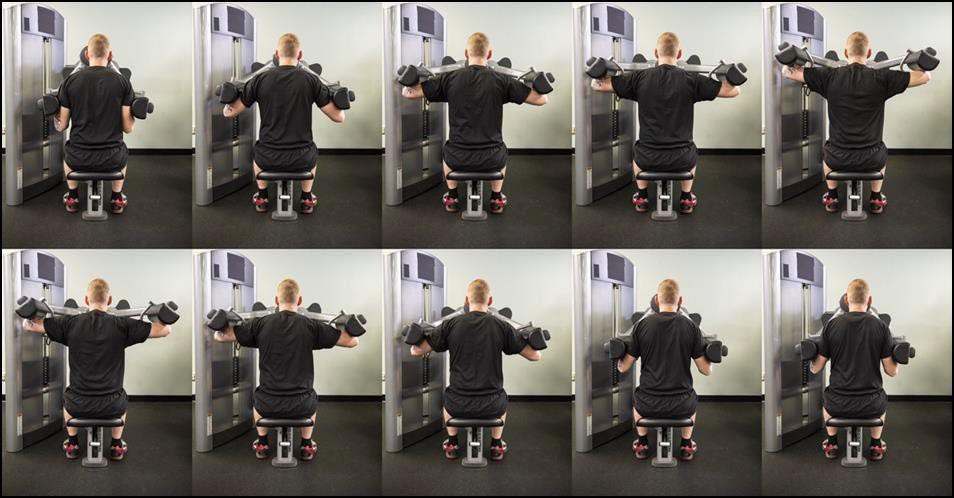
STM Lateral Raise -
Single-Arm Lateral Raise
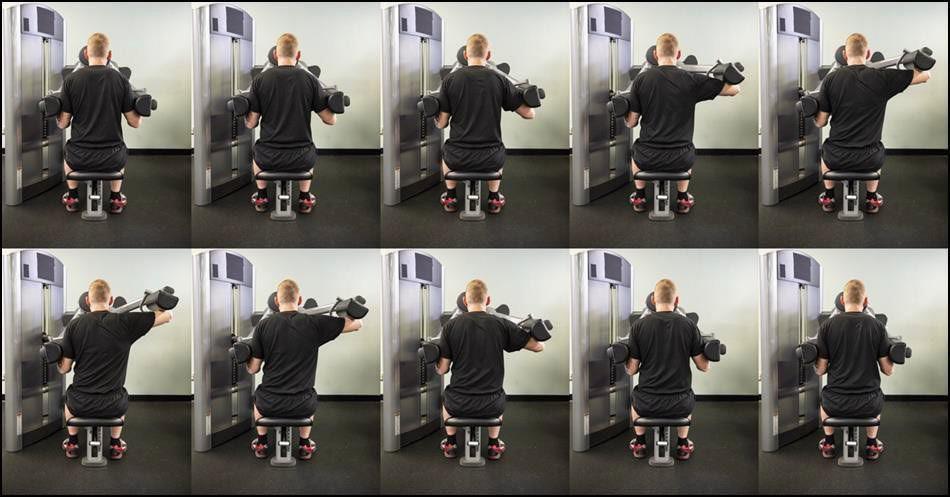
STM Single-Arm Lateral Raise -
Overhead Press
STM Overhead Press -
Lat Pull-Down
STM Lat Pull-Down -
Seated Row
STM Seated Row -
Trunk Extension
STM Trunk Extension -
Modified Trunk Extension
-
Triceps Extension
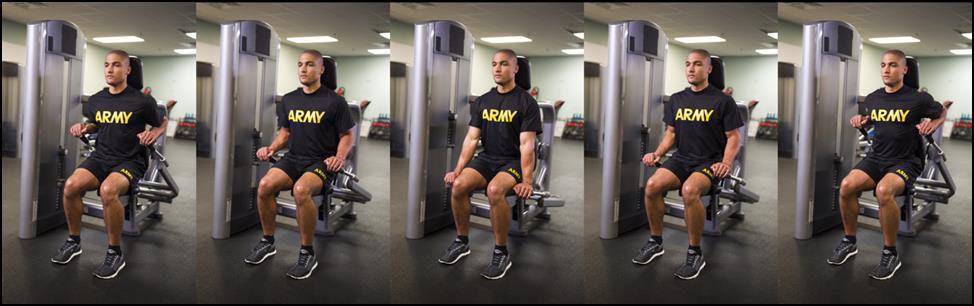
STM Triceps Extension -
Chest Press
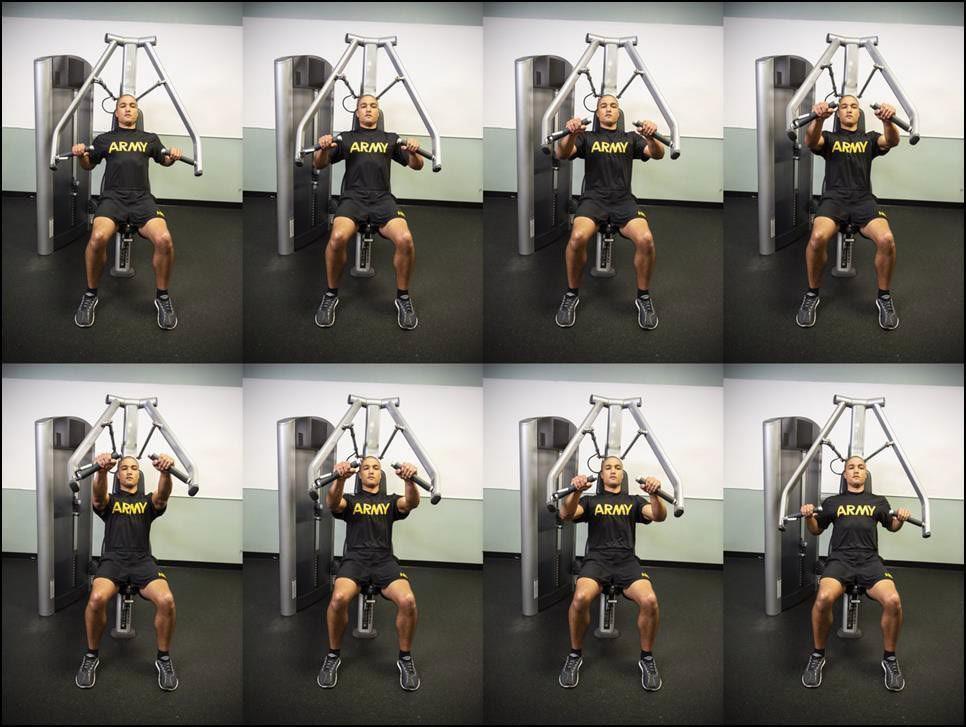
STM Chest Press -
Trunk Flexion
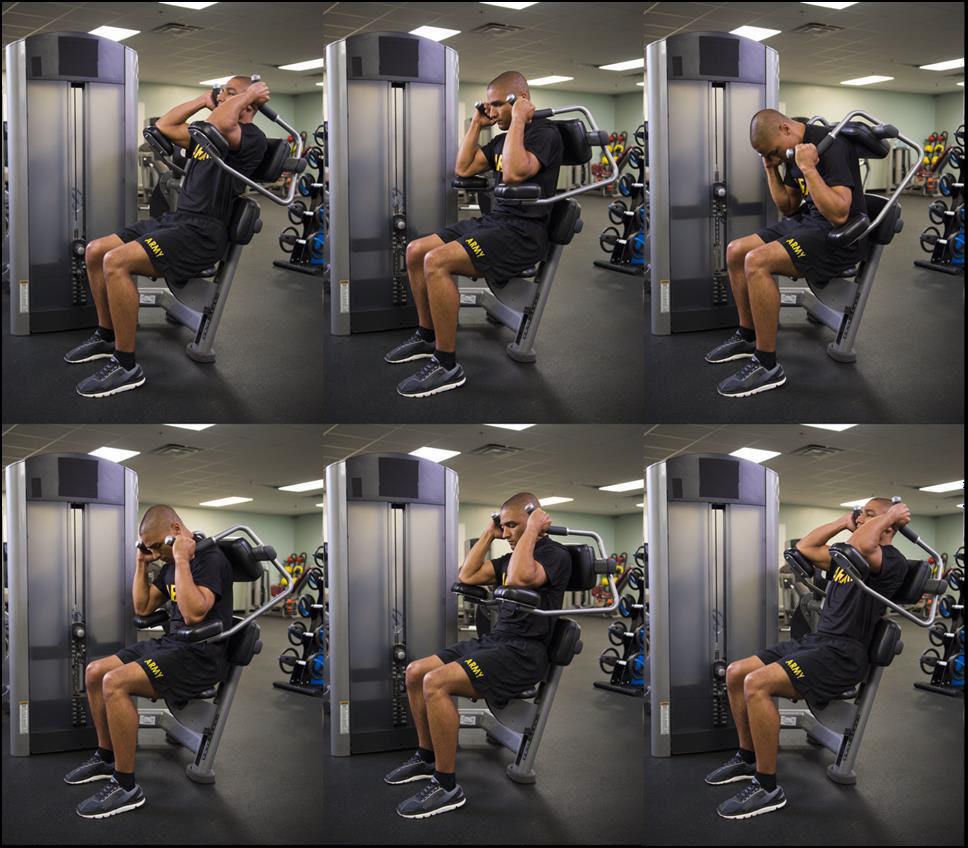
STM Trunk Flexion -
Modified Trunk Flexion