-
I Raise
The first exercise for the Shoulder Stability Drill is the I Raise. Perform the exercise at a slow cadence:
- The starting position for the I Raise is the Prone position with arms laying parallel to each other on the ground above the head. This is the I position. The head is slightly elevated. Feet are together and toes are pointing rearward. Fingers and thumbs are extended and joined with palms facing each other.
- On the count of 1, raise both arms from the ground 3–6 inches while continuing to keep the elbows straight. The head remains in its starting position.
- On count 2, return to the starting position.
- On count 3, repeat count 1.
- On count 4, return to the starting position.
-
T Raise
The second exercise for the Shoulder Stability Drill is the T Raise. Perform the exercise at a slow cadence:
- The starting position for the T Raise is the Prone position with arms laying on the ground straight out from the shoulders at 90 degrees to the trunk. This is the T position. The head is slightly elevated. Feet are together and toes are pointing rearward. Fingers and thumbs are extended and joined with palms perpendicular to the ground, facing directly ahead.
- On the count of 1, raise both arms from the ground 3–6 inches while continuing to keep the elbows straight. The head remains in its starting position.
- On count 2, return to the starting position.
- On count 3, repeat count 1.
- On count 4, return to the starting position.
-
Y Raise
The third exercise for the Shoulder Stability Drill is the Y Raise. Perform the exercise at a slow cadence:
- The starting position for the Y Raise is the Prone position with arms laying on the ground extended overhead at 45 degrees to the trunk. This is the Y position. The head is slightly elevated. Feet are together and toes are pointing rearward. Fingers and thumbs are extended and joined with palms facing each other.
- On the count of 1, raise both arms from the ground 3–6 inches while continuing to keep the elbows straight. The head remains in its starting position.
- On count 2, return to the starting position.
- On count 3, repeat count 1.
- On count 4, return to the starting position.
-
L Raise
The fourth exercise for the Shoulder Stability Drill is the L Raise. Perform the exercise at a slow cadence:
- The starting position for the L Raise is the Prone position with arms laying on the ground straight out to the side at 90 degrees to the trunk and elbows bent to 90 degrees. Hands are at head level with palms facing the head. This is the L position. The head is slightly elevated. Feet are together and toes are pointing rearward. Fingers and thumbs are extended and joined with palms facing each other.
- On the count of 1, raise both arms from the ground 3–6 inches while continuing to keep the elbows bent. The head remains in its starting position. The elbows, forearms, and hands should leave the ground at the same time.
- On count 2, return to the starting position.
- On count 3, repeat count 1.
- On count 4, return to the starting position.
-
W Raise
The fifth exercise for the Shoulder Stability Drill is the W Raise. Figures 4-10 and 4-11 show the exercise as performed in a formation at a slow cadence:
- The starting position for the W Raise is the Prone position with arms on the ground at 45 degrees to the trunk and elbows bent to 45 degrees. This is the W position. The head is slightly elevated. Feet are together and toes are pointing rearward. Fingers and thumbs are extended and joined with palms facing each other.
- On the count of 1, raise both arms from the ground 3–6 inches while continuing to keep the elbows bent. The head remains in its starting position. The elbows, forearms, and hands should leave the ground at the same time.
- On count 2, return to the starting position.
- On count 3, repeat count 1.
- On count 4, return to the starting position.
-
I Raise
-
T Raise
-
Y Raise
-
L Raise
-
W Raise
-
I Raise
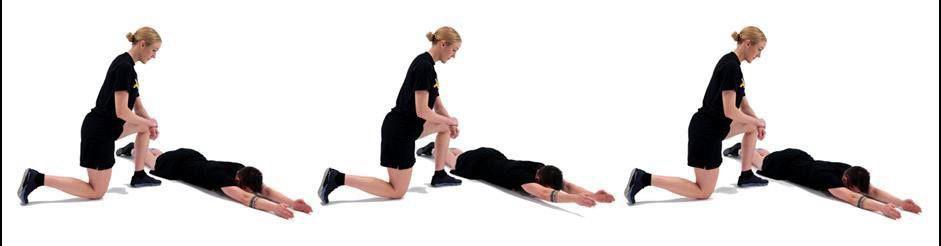
SSD1 I Raise -
T Raise
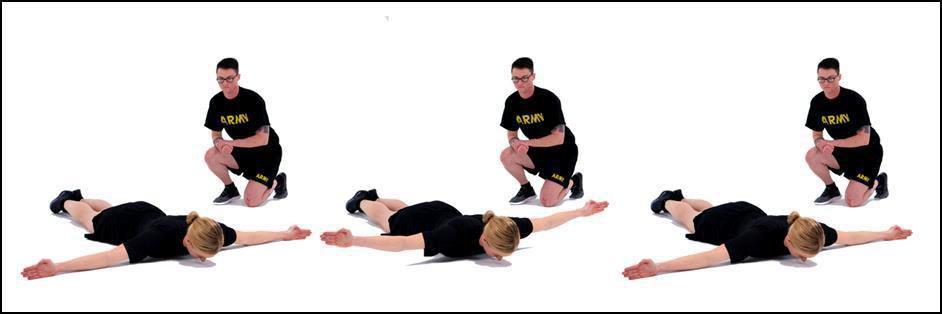
SSD2 T raise -
Y Raise
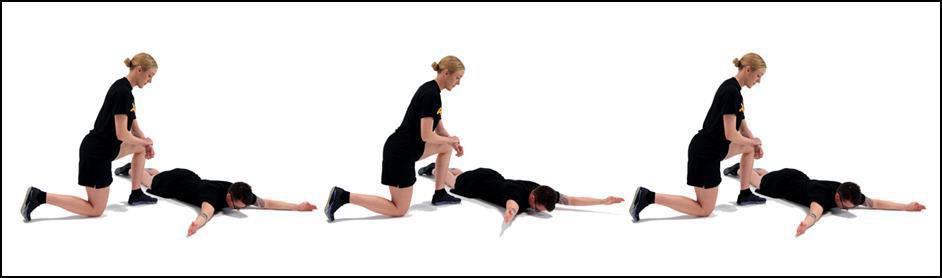
SSD3 Y Raise -
L Raise
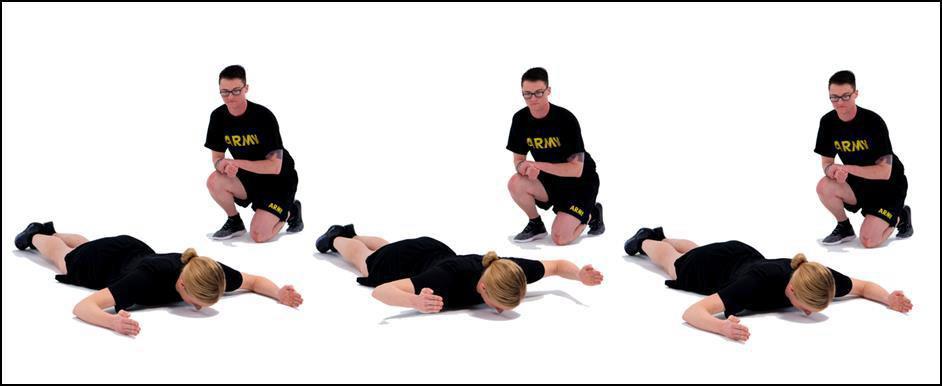
SSD4 L Raise -
W Raise
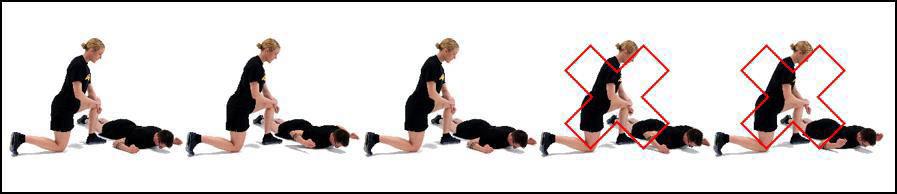
SSD5 W Raise with improper form 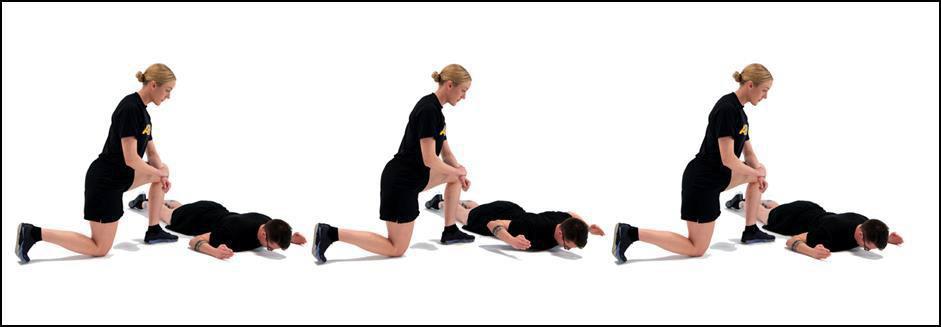
SSD5 W Raise